Waterhouse Brands is a boutique life sciences agency working at the nexus of brand, culture and communications. Their clients are emerging and fast-growth biotech companies - the kind navigating a readout, a raise, or a first commercial launch, where a brand decision is also an investor-relations decision.
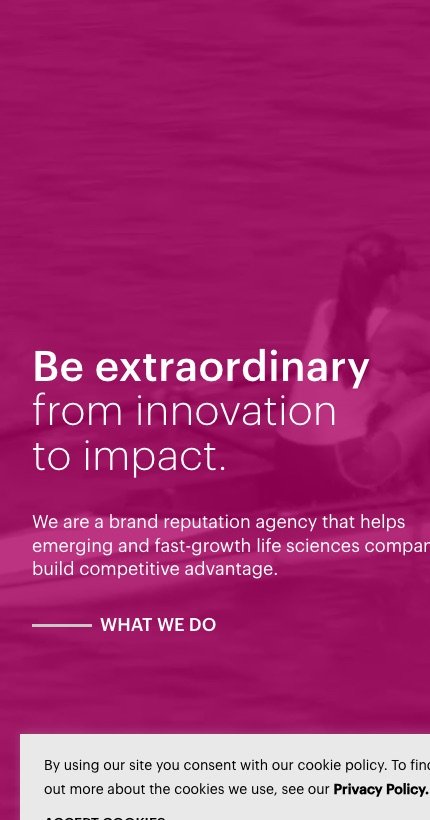
Their positioning is "Be extraordinary from innovation to impact." Two pieces of work came out of the engagement: the public website, and an internal AI agent the team uses on client deliverables.
A custom WordPress build - bespoke theme, no page-builder - designed around the constraint that this is a firm whose product is judgment. The site has to read as considered rather than busy, so the work leans on generous whitespace, restrained typography, and full-bleed imagery that does the emotional lifting while the copy stays plain.
Under the hood it's a modular template system: the team composes case studies and service pages from a fixed set of blocks rather than filing a ticket for every layout change. Same principle we apply to email component libraries, applied to a marketing site.

The more interesting half of the engagement. Waterhouse runs a four-phase strategy methodology - Assess, Listen, Interpret, Galvanize - that produces long-form strategic documents: competitive audits, stakeholder synthesis, insights reports, and full brand positioning platforms.
Like every agency, they had started using LLMs somewhere in that drafting process. And for a brand agency specifically, generic LLM prose is not a cosmetic problem. It is an existential one. Clients pay for a point of view, and the failure mode of an LLM is confident text with no position in it.
Their voice was already documented. It just wasn't enforceable. A tone-of-voice deck is advice - everyone nods and then writes however they were going to write. What they needed was a gate.
ALI encodes the house voice as a machine-checkable system rather than a style guide, and it knows which phase of the methodology it is operating in - the register for a stakeholder synthesis is not the register for a tagline.
Tier 1 is a hard ban - AI editorialization openers, scaffolding phrases, promotional filler, em-dashes. Tier 2 is use-sparingly, capped at one well-earned instance per section and requiring written justification to keep. Tier 3 is structural and needs craft judgment.
The part most voice systems skip. A list of what to avoid produces competent, flat prose. So the system also documents what good looks like - quoting a stakeholder phrase as the analytic anchor, stating a productive contradiction as a position, landing every section on a concrete behaviour.
Catalogued specifically for what happens when one model polishes another model's output: hedge verbs replacing assertion, wordy nominalizations, the "while also allowing for" caveat, restatement dressed up as analysis.
A Python audit script that sweeps for banned phrases, em-dashes, antithesis constructions, tricolons, and runs of same-length sentences. It exits non-zero on hard violations, so it can sit in front of delivery as an actual gate.
Three approved client positioning platforms are included as reference. "Does this hit the standard" becomes a comparison against real shipped work rather than an argument about taste.
For platform work, the agent enforces structure as well as voice: settle purpose, audience, positioning and USP before drafting language; claim the audience outcome rather than the company function; coordinate every layer around one operative concept.
Rules the machine can check, judgment the human keeps
ALI is deliberately two-layered. The deterministic linter handles everything literal - a banned phrase either appears or it doesn't, an em-dash is or isn't there. That work is mechanical, it should never require a model, and running it as code makes it fast, free and impossible to argue with.
The model handles what the script cannot see. Is this three-item list substantive enumeration or a rhythmic tricolon? Is this the one earned antithesis in the section, or the fourth? Has the writer taken a position the reader could disagree with, or written something merely plausible?
Neither layer works alone. A linter with no judgment produces prose that passes every check and says nothing. A model with no linter drifts, because "avoid AI tells" is exactly the kind of instruction models are worst at holding across a long document.
Automate the check, not the taste. The agent's job is to make the standard unavoidable - not to have opinions on behalf of the strategist.
ALI was built first for a terminal-based agent runtime with real file and shell access, which is where it works best. But most of the agency doesn't live in a terminal, so it's also packaged as a Custom GPT: the same rulesets as knowledge files, with the audit script translated into a structured manual self-check for a runtime that can't execute code.
The result is that a voice standard which used to live in a document - read once, half-remembered, applied unevenly - now runs as a step in the process. Drafts get audited before they reach a client, violations come back with line numbers, and the arguments that used to be about taste are now about evidence.